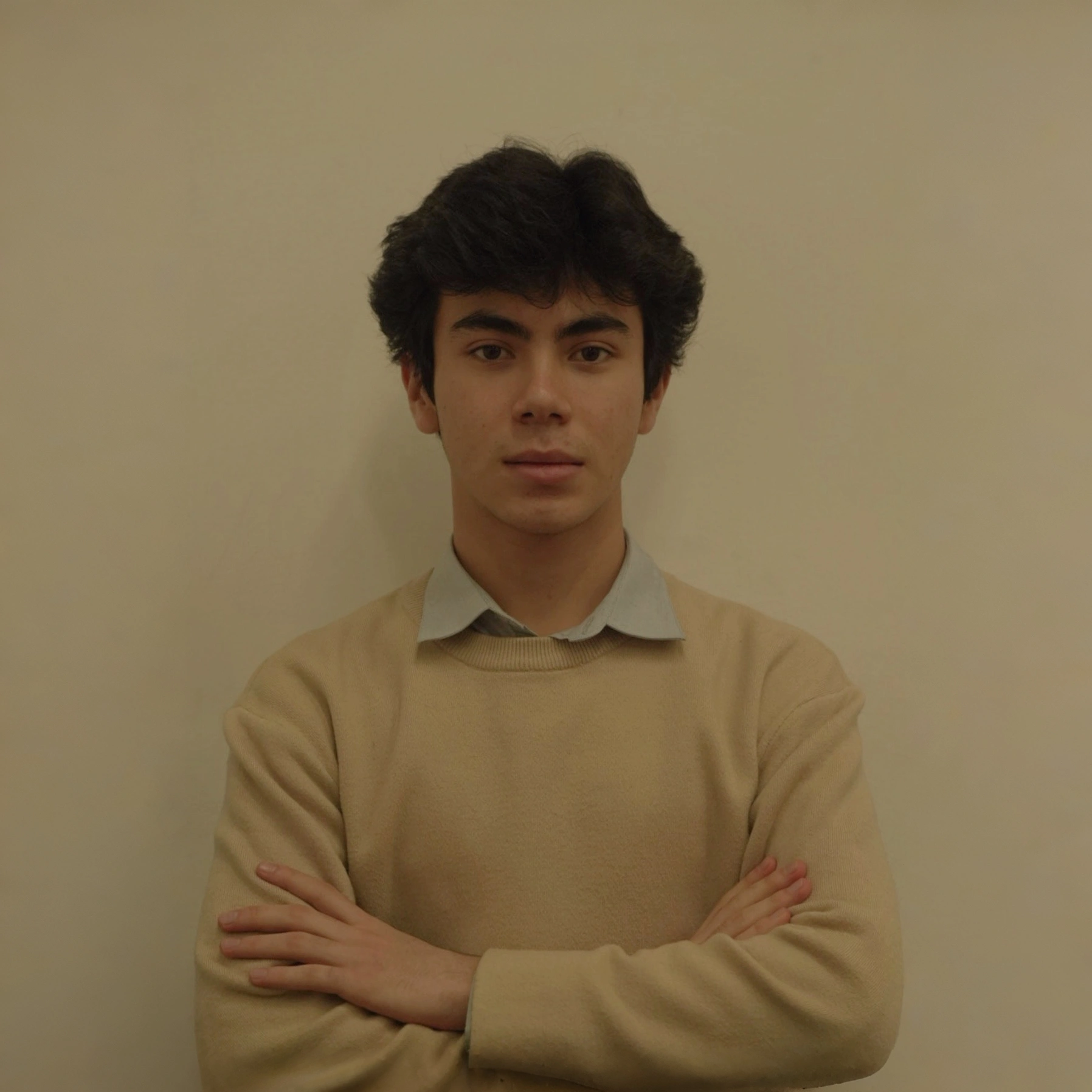
Profile

Shahriyor Amirov

Hello world!

I’m Shahriyor. Yes, it is 2026. I’m sitting at my workplace, missing deadlines while filling out my webpage, and wondering what to write in my biography, since I have a lot to say. But I have very few meaningful things to write. We’ll see what is going to happen, and how loudly I’ll be laughing after reading these letters ten or more years later.

I want to start this essay by referring to the most invaluable vague dimension. There’s nothing that belongs to me in this world except it. That’s time. I love the way everything changes depending on it. In one period, you have a whole different perception and way of life. In another, you may feel like a complete stranger to your past self. At this time, just a couple of years ago, when I was a teenager, grazing stock along the Darg’om canal (an irrigation canal located in the Samarkand Region), while thinking about why Earth isn’t flat instead. Of course, these kinds of thoughts were and will be wired to our nature.

I admire this world as a whole and, honorably, the ones who criticize me, as only they can notice all the petty details from my actions that I have no wisdom to spot. I do not consider myself someone who knows everything. Not a writer. Not someone who is circled around a certain ideal. I’m not trying to sound cool. Not trying to feel superior or prove something to others. Not a dude dressed up as a philosopher. Not the egocentric pessimist who rejects every single ideal.

What do I? I’m working for one company (Unlock Admissions). Took a gap year. Considering applying for college once I see a clear reason behind it. Maybe, currently, I’m not wise enough for higher education. Perhaps it is possible to learn more even without it. My major is PPE, specifically passionate about the field of education and shrinking the regional inequality gap.

Other than academics, I love many things, but mostly reading, writing (The best habit I have ever taken), hiking, and running marathons with my colleagues (Let’s go and cook Zamin ultra in June). You may sometimes spot a legs burning and lungs gasping guy in the Pakhtakor Sport complex or the Eco park.

I have neither pride nor shame in myself, as all the things that I have done so far may seem great for somebody, while for another, they can be just trivial deeds. And that’s why it is pointless to compare oneself with others. Because at the end of both spectrums we have so called Погрешность (btw, my favorite word in Russian), which means margin of error.

That’s somewhat more than enough about me. You can find out more if you scroll through the following pages.

Work

On Work & Life

Before describing my job, let’s reflect on life. Reminisce some events that shaped the world. Let’s attempt to predict nuances about the comming future. Most of us heard the news about current economic conditions of Uzbekistan. Recent years our economy has witnessed noticable growth: Once a country which mainly relied on agriculture, manufacturing, construction and commodity exports suddenly became among world’s leading startup ecosystems (Source: StartupBlink). And that shift tells something deeper a country that once traded goods is now trading knowledge, expertise, and services. The service economy is no longer a foreign concept here. it is quietly becoming the backbone of how young Uzbeks earn, build, and think. Suprisingly, it is much positive than I ever expected.

Surely, we have no clue where we will end up after 10 years. But that’s our duty to be positive about the outcome. For that reason, I’m not obliged to give up all of my truest goals that I wanted to achieve for the rest of my life. And I’m not willing to waste a penny of my effort for meaningless dreams that were ingrained to my brain superficially as all those trivial things that shake the world, indeed, have no reason to exist.

For years I carry a huge rock while climbing to the top of the mountain. Each time when I think I made it, the rock slips through my hands. Then I fall off by chasing the rock. After hitting the rough bottom of the mountain range, one question comes to my mind: What am I doing and Why am I here?

And here 18 years old Shahriyor is thinking for what purpose I got a job at Unlock admissions as The Quality Assurance Manager. And for what purpose I ended up being as an informal Security Guard at the Education Center. Long ago, I, actually, dreamt of having private library or coworking zone where I can work for nights. Perhaps, God sent me to the right paths which may lead to my destiny. Exactly for that purpose I will never stop climbing the mountain while carrying the huge rock. It will certainly be placed on the mountain top one day. And so I might get that answer after hundreds maybe thousands or more tries.

Projects

What I’m Running

I’m running few projects these days: one is The Economic Forum, where people interested in Economics and Public affairs gather to network with each other.

The next one is Agora Talks. The reason behind this club was very simple: just to read books with my friends and discuss them. But soon we grew bigger. Just discussions of books and sharing ideas. No debates. No performative social pressure. Join here to find out more

I love writing, and thus I had a dream of publishing my own articles. This is one example. As I will get more time and become more knowledgeable in my field, I want to publish regularly. Because the one who knows nothing about what he is referring to shouldn’t have the right to teach someone.

The last one is this website. I created it for my own personal benefit: to see myself how I was in the past; what I have done so far; What I was thinking at a certain period; how wrong I was, and so on. A huge part was played by historical figures who regularly wrote about their life and I read their books, and their actions inspired me a lot. Now the technology is developing at an unprecedented rate, so we have a great chance to share our lives not only through books but also through the digital network, where you can upload whatever you want. That’s the primary reason why we have social media platforms with billions of users. But I’m tired of being active across dozens of platforms, each intended for a specific purpose. While here, I have complete freedom over my choice. There’s no metric telling what I should upload. Whether my writing was good enough or not. No frame to follow. Shahriyor is a human, and I can make mistakes. Be skeptical of what I share here.

Books

The Shelf

I read slowly and reread often. These are the books I return to — the ones that left a mark. · Glowing dot means I've written a reflection — click to read.

Philosophy & Essays

Essays Montaigne
On the Shortness of Life Seneca
The Prince Machiavelli
The Myth of Sisyphus Albert Camus
Thus Spoke Zarathustra Nietzsche
Beyond Good and Evil Nietzsche
On Bullshit Harry Frankfurt
Muqaddimah Ibn Khaldun
12 Rules for Life Jordan Peterson

"Any friendship that can be fully explained by a reason, Montaigne suggests, is fragile."

In Montaigne's essay On Friendship (De l'amitié), there is a chapter about the Rarity of True Friendship. Montaigne says that genuine friendship is extraordinarily rare, perhaps a lifetime. He distinguishes it from ordinary relationships, acquaintances, and even family bonds, which cannot match true friendship.

Most relationships are conditional while true friendship is not. If you are friends with someone because they are useful to you, it most likely ends when the usefulness ends. If you are friends with someone because they are pleasant, it ends when the pleasure fades. If you are friends with someone out of obligation, it is not freedom, so it is not true friendship. And he points that friendship is backed by something which is beyond language and reason.

Montaigne dedicated this chapter to La Boétie, a brilliant French magistrate and writer who became Montaigne's closest friend around 1558. Their bond was immediate, deep, and total. La Boétie died just a few years later at the age of 32, likely from plague, with Montaigne at his bedside. The essay on friendship is essentially Montaigne's grief made into philosophy.

"—All things are foreign to us. Time alone is ours."

One of his essays is about Time. It is without doubt the oldest problem that never got solved. Two thousand years have passed since Seneca wrote these letters. In 2026, we have smartphones, calendars, productivity apps, and self-help industries worth billions — all of them only to make our lives more convenient. And yet we still feel like time is slipping through our fingers.

The problem is not a lack of tools. The problem is that we became terribly ignorant to ourselves. Definitely worth reading as a short essay when you're on the subway without internet.

You can't really get good at anything if you're not fully focused — your mind just "bounces off" what you're trying to learn instead of taking it in. Even if you try to hammer information into someone's head, it won't stick if they aren't locked in.

"All values and beliefs are relative — we should strive to create our own rather than following those of others."

Beyond Good and Evil challenges traditional morality and philosophy. Nietzsche’s main focus is to move beyond the limitations of traditional morality to create a new way of thinking about life and the world.

Nietzsche argues that good and evil are not fixed concepts, but are relative to the culture and society in which they exist. He suggests that we should embrace this relativity and create our own values and beliefs.

"One of the most salient features of our culture is that there’s so much bullshit. Everyone knows this. Each of us contributes his share."

Harry Frankfurt distinguishes bullshit from lies: a liar knows the truth and is trying to convince us of something different, while a bullshitter either doesn’t know the truth, or doesn’t care — and is just trying to be persuasive, impressive and manipulative.

A society mired in bullshit can’t recognise the difference between truth and lie at all. We give opinions on things we haven’t read. We always pretend to be doing something — endlessly busy, endlessly productive, endlessly active. The real answer isn’t “to be noticed” but that it is more appealing to live inside our illusions.

Novels

The Little Prince Saint-Exupéry
The Alchemist Paulo Coelho
Old Man and the Sea Hemingway
The Great Gatsby F. Scott Fitzgerald
The Duel Chekhov
Invisible Cities Italo Calvino
The Metamorphosis Franz Kafka
Martin Eden Jack London
The Hobbit Tolkien

"One morning, Gregor Samsa woke up and found himself transformed into a monstrous insect. His family’s first concern? He’ll be late for work."

Kafka wrote The Metamorphosis in 1915. Yet it has never felt more relevant for the worker to exist, the family suffocating under debt, the individual slowly erased when he can no longer perform his function.

Is Gregor the one who changed? Or did the transformation simply make visible what was always there?

"Everything about him was old except his eyes and they were the same colour as the sea and were cheerful and undefeated."

The Old Man and the Sea possesses a timeless, universal quality — which is probably why people are still devouring it. The plot is simple: an old man goes fishing. He is considered salao — the worst form of unlucky — and hasn’t caught a fish in eighty-four days.

A story about the test of endurance, pride, and the human spirit. Maybe I’m the TikTok generation who is insanely impatient. If I were that old man, I would just throw that fish.

"All his life he had not planted one tree in his own garden, nor grown one blade of grass; and living among the living, he had not saved one fly."

As the moment of the duel approaches, Laevsky begins to think about death and life constantly. The closer it gets, the more he panics — not because of being killed, but he realises how empty and wasted his life is. Chekhov wants the reader to see that Laevsky’s fear isn’t death but facing the truth of what he had done with his life.

In our lives we also hide from responsibilities, repeat the same excuses, and convince ourselves that “later” we will become better. As Dostoyevsky says, “Your worst sin is that you have destroyed and betrayed yourself for nothing.”

Chekhov and Dostoyevsky tell us that the tragedy is not failure or hardship, but living without ever asking what our life is.

Dystopia & Politics

Animal Farm George Orwell
Brave New World Aldous Huxley
1984 George Orwell
Fahrenheit 451 Ray Bradbury
Politics & the English Language Orwell

"Bad writing makes it easier to defend the indefensible because it lets you avoid confronting what you’re actually saying."

Orwell argued that the lack of clarity in political writing was not just linguistic incompetence, but intellectually and morally corrosive. Politicians, trying to defend the indefensible, will not write “defenseless villagers are bombarded from the air” but “pacification.”

And then there is the shrinking of language — the most chilling idea. Why would a totalitarian regime want to get rid of words? Because if you remove the word for a concept, you remove the ability to think it. “In the end we shall make thought-crime literally impossible, because there will be no words in which to express it.”

Orwell wants us to bear in mind that the decay of any language is never accidental. If we lose control of our words, it is inevitable that we lose control of our thoughts.

"Schools banned this book. What an irony. A book which warns about the danger of banning books, was removed from American libraries for decades."

In this universe, firemen don’t extinguish fire. They ignite it. And it’s always ignited on books.

But Bradbury wasn’t writing about a distant future. Decades later, it feels more like a prophecy.

"War is peace. Freedom is slavery. Ignorance is strength."

In a ravaged post-apocalyptic future, the world has divided itself into three totalitarian superpowers. Winston works in the Ministry of Truth every day revising, rewriting, and burning history records to match the ever-changing version dictated by Big Brother.

The totalitarian regime not only wanted obedience — they wanted to take control of thoughts. The idea of shrinking the dictionary was to prevent potential threats by minimising the spread of radical ideas. Orwell wants us to bear in mind that the decay of any language is never accidental. If we lose control of our words, it is inevitable that we lose control of our thoughts.

"The animals overthrow their human master. Freedom at last. Equality for all. A perfect society… for about five minutes."

In 20th-century England, George Orwell wrote about a farm and turned it into a political theme. Then the pigs take charge. Rules change. Truth disappears. History gets rewritten while everyone is looking the other way.

Most people pick up Animal Farm thinking it’s just a book about the Soviet Union. But Orwell isn’t just talking about 1917. He’s talking about us. How quickly we believe slogans. How easily we trade freedom for comfort. By the time you notice what happened… it’s already too late.

History & Society

Why Nations Fail Acemoglu & Robinson
Sapiens Yuval Noah Harari
Homo Deus Yuval Noah Harari
Очерки Русской Смуты Деникин

Central Asian

Bukhara Sadriddin Ayniy
Starry Nights Pirim Kadirov

Science Fiction

The Profession Asimov
The Last Question Asimov

"The world where children do not go to school. Instead, knowledge is uploaded directly to the brain."

A young man George Platen fails the test. The machine rejects him, but his dream doesn’t die. Because George is different, not defective. While everyone else is programmed with knowledge about everything from tiny cells to the structure of big stars, George picks up a real book and opens it.

And at that moment George understands something the machine can never understand. It wasn’t just about storing information. It was about discovery, struggle, and imagination.

Anyone who has finished a standardised education should read this. Most people ignore or forget that economics, money, law, and even culture are completely made up by other people.

"You will read the same story seven times. Each time, billions of years pass. Each time, humanity will ask the same question."

Each time the answer is the same: INSUFFICIENT DATA FOR MEANINGFUL ANSWER. Until it isn’t.

The question will be asked by two drunk men. And it will be answered by god.

One of the best books I have ever read.

Analects

Read essay →

All Entries

My World

Hometown Living now City School Memory Park ★ Landmark Home away Sport

Click a pin

Explore my places

Born in Samarkand. The road since then has taken me across Uzbekistan — each city a different mood, a different tempo.

Click any marker on the map to see photos, memories and reflections from that place.